
Scratch Tile: Frank lloyd Wright’s material influence on east asian modern architecture
By Nathaniel Talbot Kornegay and Jihoon Suk, Copyright 2024
(Paperback)
WHY AM I BEING REDIRECTED TO THE PRINTER’S WEBSITE?
PUBLICATION & PURCHASING NOTE
Scratch Tile was challenging to bring to print. Not only are large, photography books difficult for publishing companies to accept, but Scratch Tile‘s niche subject matter meant doing a print-run of any size made little financial sense. Rather than allow this project to collect dust on the proverbial shelf until the right, large-scale publishing company comes along, it has been released as a print-on-demand paperback. You may click the link to directly order Scratch Tile from the printer. The book will then be printed and shipped directly to you. By choosing to buy through the printer, you are choosing to directly and financially support nine years of research work and data-collection. We greatly appreciate your support for this project.
Years ago, this book was imagined as a premium print worthy of any avid reader’s coffee table. With printing costs increasing alongside global economic inflation, we have instead opted to prioritize making the book as financially and logistically accessible as possible. Recognizing that the historical information and photographic reference material in Scratch Tile is in many ways more valuable than the paper it is printed on, the $59.99 paperback version is of an economical, matte-finished, textbook quality on 60 GSM paper.
We are considering creating a premium version of Scratch Tile in the $100-200 price range in the future. If you are interested in a collectible, higher-quality version, please write to us using the Contact Form and we will add your note to our market research. We will also keep you updated on whether or not the premium version goes to print and becomes available. We greatly appreciate your support for this project.

SHIPPING
SHIPPING NOTE
On average, standard shipping from the printer currently costs around USD $10-25 (the exact cost is calculated upon checkout and may be more or less depending on your country and your selected delivery speed). While, in the future, Scratch Tile could be distributed through major retailers with slightly cheaper shipping costs, the reality is that all major online retailers and logistics companies have been increasing domestic and international shipping rates since 2020. Since Scratch Tile is a heavy, 2 lbs., 530-page book, it has been difficult to work around the issue of high shipping costs when bringing the book to print. The cost of shipping is expensive now; however, the upside is Scratch Tile is globally available and accessible. We appreciate your understanding and support.
RETURNS & REFUNDS
RETURNS & REFUNDS NOTE
As a general rule, all sales are final and GIWA HOUSE PRESS does not accept returns or provide refunds. If you have an issue that you sense is the result of extenuating circumstances, such as print quality errors, please use the Contact Form and GIWA HOUSE PRESS will take the issue under consideration.
BOOK SUMMARY
Scratch tile is well-recognized today among a handful of scholars and architects familiar with Wright’s Imperial Hotel in Tokyo. Less known is the tile’s impact on the built environment across 1920s-1940s East Asia, where it quietly defined the feeling, color, and lived experience of urbanity in the modern era. The Japanese Empire’s far reach meant modernizing cities throughout the metropole, Korea, Taiwan, China, and Manchuria were gradually christened with the yellow-brown tones and textures of scratch tile and its derivatives. Even less known are the tile’s origins in 1910s America, where it was patented and popularized by a Midwestern manufacturer whose textured bricks were used and imitated throughout the United States before arriving in 1920s East Asia.
Featuring more than 450 photographs and illustrations demonstrating the tile’s origins in America and subsequent spread through East Asia, Scratch Tile tells the story of what happened before and after Wright’s decision to use this distinct type of architectural cladding in Tokyo. The result is a compelling historical and pictorial work on an understudied architectural building material that offers insight into its use by the historical personalities involved, its role within the evolution of brick and tile trends, and the way architectural ideas were globally disseminated in the 20th century.
BOOK CONTENT
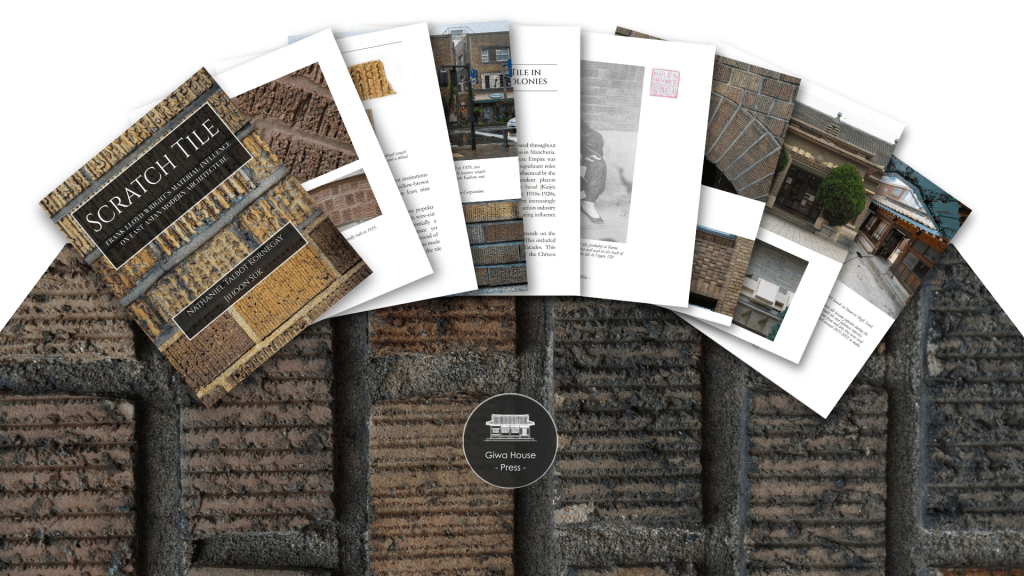
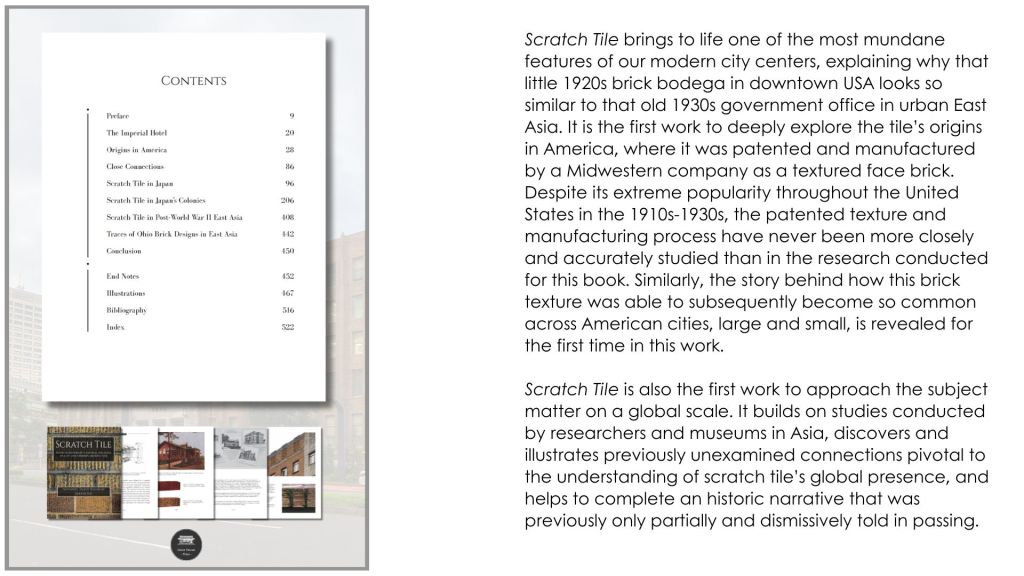

*Actual book, including front and back covers.


AUTHOR’S NOTE
Scratch Tile is the result of nine years of field research, data collection, and historical study. It compiles past findings in Asia with new information and conclusions to form a near-comprehensive and holistic understanding of the tile’s origins and impact across the world. It is not another book about Wright, yet followers of Wright may be interested to see the long-lasting influence his material choices had on architecture built after the Imperial Hotel in Tokyo. Brick historians and collectors in the United States may be interested to learn more of the textured American brick that would inspire scratch tile in Asia. Scholars of modern architecture in East Asia may find Scratch Tile to be an invaluable reference book and architectural catalog showcasing both novel and mundane examples of the tile’s historical use.
True to the old adage that “A picture is worth a thousand words”, Scratch Tile relies on imagery to demonstrate just how far this textured tile traveled around the world. In addition to the inclusion of some historic images, Scratch Tile focuses on recent photographs (2010s-2020s) showcasing over 150 extant buildings. Of the hundreds of remaining buildings in Asia that used scratch tile and its derivatives, the buildings featured in Scratch Tile were largely selected as a matter of personal taste in order to illustrate how it was used in both novel and mundane ways.
PROJECT RESEARCH
RESEARCH
Research conducted during this project consisted of on-site documentation across multiple countries, consultation with other experts, examination of past findings by other scholars, and “armchair” study of historical records. Historic social study was also attempted in an effort to understand, through primary sources, human perspectives on scratch tile as a building material, yet unfortunately little historic commentary was discovered in Asia. Research for this project also consisted of exploring tile manufacturing processes, patterns, consistencies, and discrepancies. Tile fragments were comparatively examined. Available or known architectural plans were referenced in an attempt to discover material intent in the various architectural examples included in this work.
Data-collection was largely closed after about eight years when it became increasingly apparent that it would be next to impossible for a team of two people to document every extant scratch tile-related building in Asia and the United States. With the global story of scratch tile now discovered and condensed into this book, we hope that other researchers and enthusiasts will help to further document, or discover, the presumed many hundreds of other extant architectural examples using scratch tile, its derivatives, and its related materials.
To join this tile-finding mission, use #scratchtile @giwahousepress on Instagram, or contact us directly to publicly or privately add to the world’s knowledge of this topic.
RESEARCH IMAGES
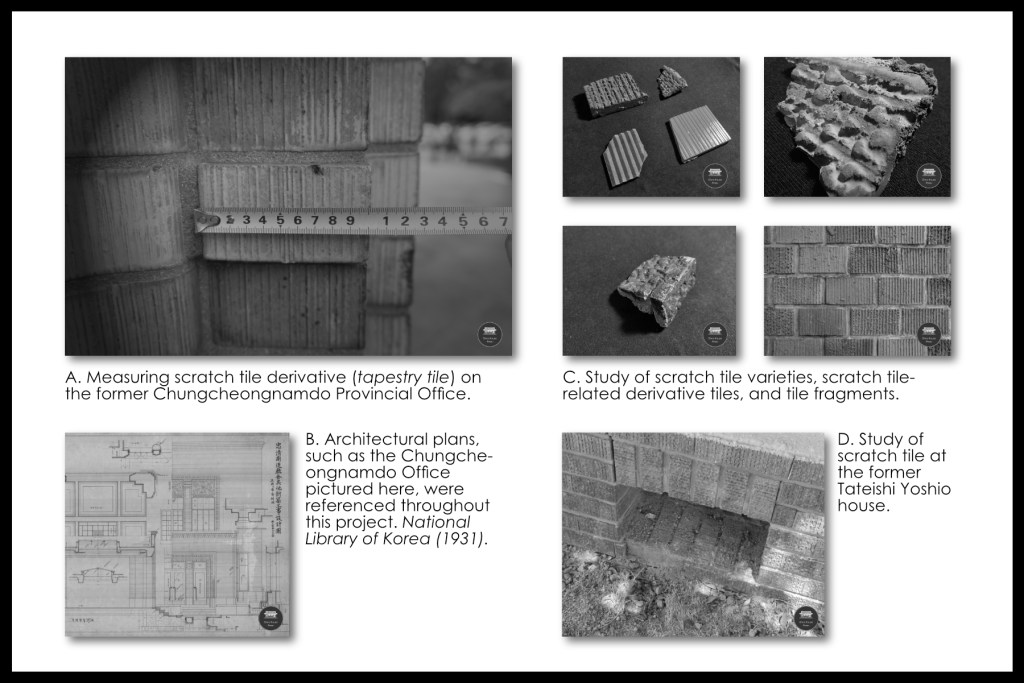
Note these “research images” are not included in the book and are included here to illustrate research processes and content. Click the “BOOK CONTENT” section on this webpage to see examples of the book interior.


Note the historic image of Hazama Gumi is not included in the book and is included here to simulate comparative historical study. Click the “BOOK CONTENT” section on this webpage to see examples of the book interior.

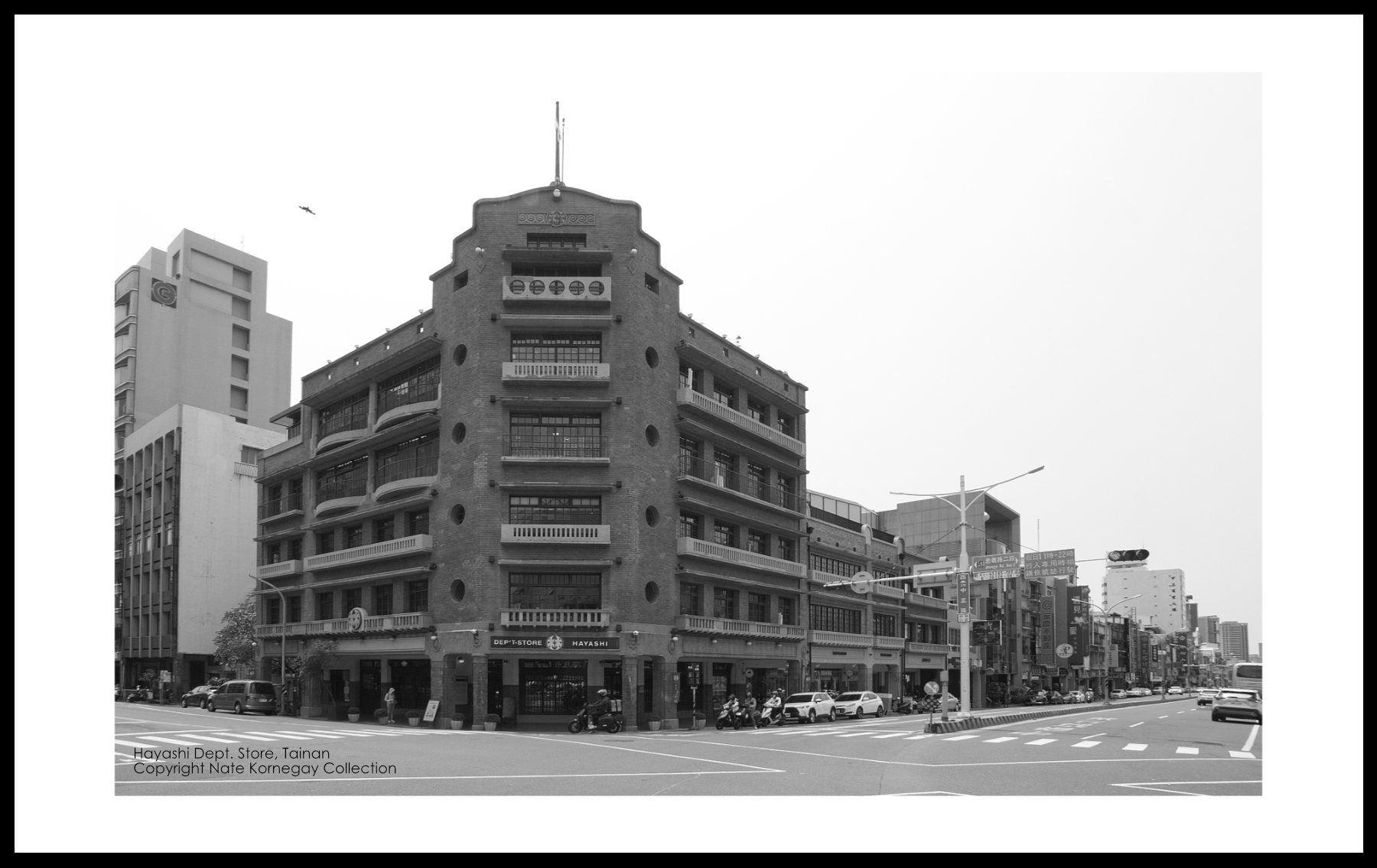
Note the historic image of Hayashi Dept. Store is not included in the book and is included here to simulate comparative historical study. Click the “BOOK CONTENT” section on this webpage to see examples of the book interior.
ABOUT THE AUTHORS
Nate Kornegay has spent a decade researching, documenting, and writing about modern architecture in East Asia, particularly architecture from the late-19th to mid-20th centuries. He created the Colonial Korea blog in 2015 to help record Korea’s disappearing built modern history and continues to periodically write essays regarding architectural history matters in East Asia. His research has focused on architectural transfer between nations and cultures and attempts to explore the lesser known details and mundane aspects of construction, design, planning, materials, and the socio-political contexts of these topics. Having received a BA in Communication from Texas A&M University and pursued a rewarding career in education, his research and writings have become noteworthy English-language resources referenced by academics, graduate students, and the media.
Jihoon Suk received his BA and MA in Korean modern history at Yonsei University. After studying in the Asian Studies program at the Asian Languages and Cultures (ALC) department of the University of Michigan, he is currently completing his Ph.D. in Korean modern history at Yonsei University. His primary research focuses on the role of modern, non-textual media in the creation of the “sense” of cultural Korean-ness in the 20th century. He is also an avid collector and archivist of vintage sound recordings and film, having worked with various museums and archives in Korea and around the world, including the Independence Hall Museum of Korea, the National Archives of Korea, the National Library of Korea, the Korean Film Archive, the National Gugak Center, the U.S. Library of Congress, the New York Public Library, and the University of Hawaii-Manoa.


 Giwa House Press